%20(3).png)
Runner Recovery Massage Case Study for Better Recovery

A runner can finish a hard week of training feeling strong overall but still notice one stubborn problem: calves that never fully release, hips that feel restricted on climbs, or a stride that has become shorter without any clear reason. This runner recovery massage case study follows a representative recreational runner whose goal was not simply to feel relaxed, but to recover with less stiffness and return to training with better movement awareness.
The details have been generalized to protect privacy, but the recovery pattern is common among runners in Medellín. Hill training, uneven routes, long desk hours, travel, and a busy schedule can all leave the legs working hard without enough time or attention for recovery.
The runner and the recovery challenge
The runner was a 39-year-old professional preparing for a 10K race. She ran four days a week, including one faster session, a weekend long run, and regular hill work. Her fitness was improving, but the final three weeks of her build brought a familiar combination of complaints: heavy calves after easy runs, tightness through the outside of one hip, and a feeling that her lower back was doing too much work near the end of longer efforts.
She was not looking for a dramatic intervention or a promise that massage would solve every training issue. She wanted practical support: less lingering tension, more comfortable movement, and a clearer sense of what her body needed between runs.
The first conversation focused on training load, recent changes in distance or pace, work posture, sleep, hydration habits, and how the stiffness behaved. Did it ease after warming up? Did it worsen after sitting? Was it localized or spread through the leg? These details help guide a session without trying to diagnose a condition.
Her pattern suggested that recovery had fallen behind training demand. The calves were carrying repeated uphill work, while prolonged sitting appeared to be contributing to hip stiffness and reduced movement through the front of the body. Rather than treating one painful spot in isolation, the plan considered how her feet, calves, hips, glutes, and lower back were sharing the work of running.
What the massage session focused on
The first session was built around sports massage and therapeutic bodywork, with pressure adjusted continuously to her comfort and tissue response. A recovery session should not leave a runner feeling bruised or unable to train for days. Deep pressure can be useful in selected areas, but more pressure is not automatically better.
The practitioner began with broad work through the lower legs and thighs to assess general tension. The calves were clearly overactive, particularly after repeated climbs, but the focus did not stay there. Targeted work through the soles of the feet, calves, hamstrings, glutes, and hip area helped address the connected regions that influence how the legs load during a run.
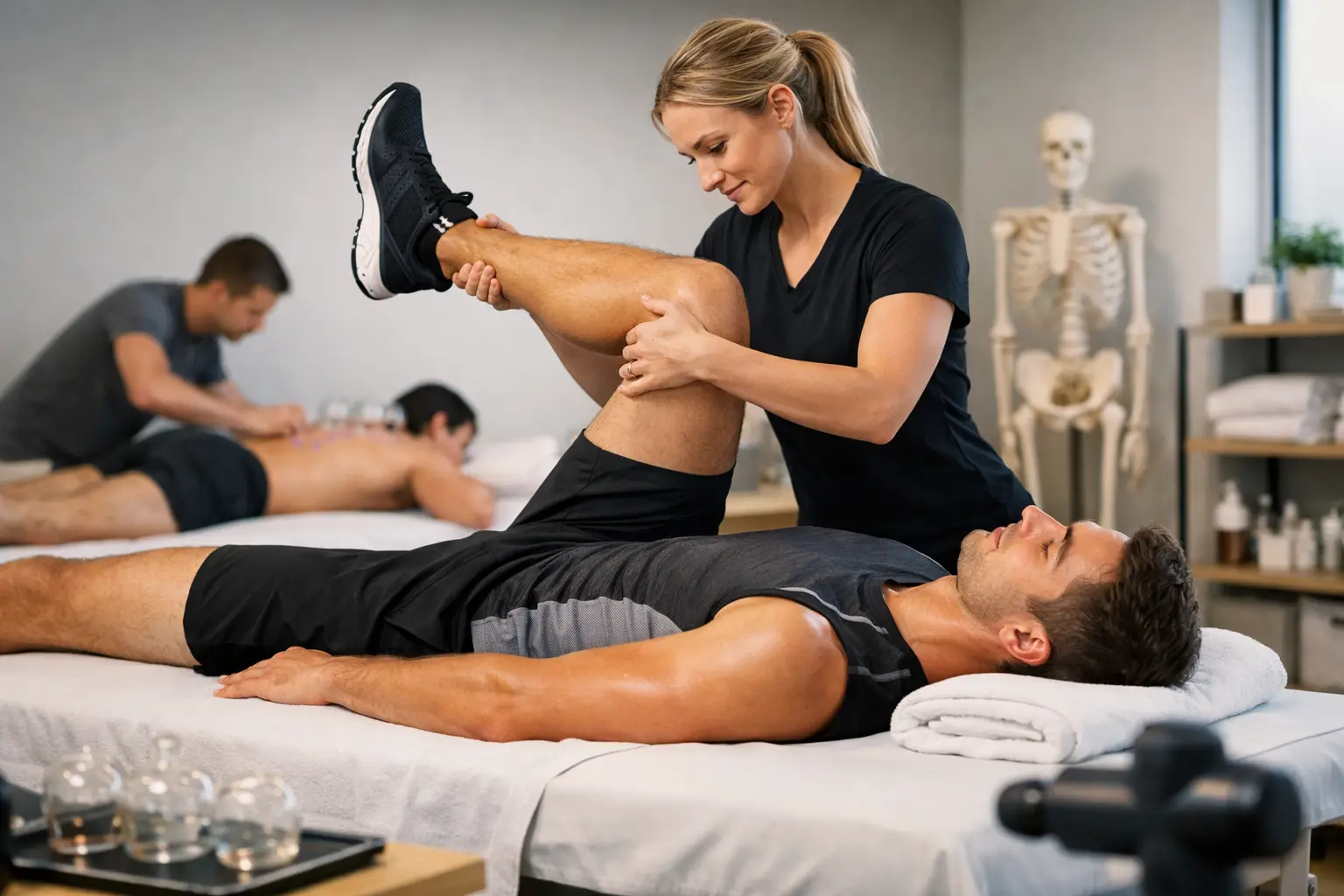
Myofascial techniques were used where the tissue felt restricted, while slower compression and release work helped reduce the guarded feeling around the hip and glute muscles. Assisted stretching, inspired by Thai massage techniques, was added carefully to explore hip movement without forcing range. The goal was to help the runner sense a difference between a productive stretch and the urge to push past discomfort.
This was not a passive appointment where the runner simply waited to be fixed. She was asked for feedback throughout: whether a sensation was sharp, whether pressure referred elsewhere, and whether the work changed the feeling of the leg when she stood up. That communication matters. An effective therapeutic massage session is tailored to the person in front of the practitioner, not copied from a standard routine.
Why the calves were not treated alone
Many runners point to their calves because that is where fatigue is loudest. Yet calves can tighten in response to limited ankle movement, hip fatigue, changes in footwear, a sudden increase in hills, or compensation higher up the chain. In this case, treating only the lower legs might have provided brief relief without addressing the runner's overall movement pattern.
The session therefore balanced local work with attention to the hips and glutes. After the massage, the runner reported that her legs felt lighter, but the more useful change was that she could stand and walk with less pulling through the outside of the hip. That immediate shift was treated as feedback, not as proof that one session had permanently corrected the issue.
The plan between sessions mattered
Massage can support recovery, but it works best when it fits a sensible training week. The runner was encouraged to keep her next easy run truly easy, avoid adding an extra hard workout because she felt better, and pay attention to whether her stride felt more natural at a relaxed pace.
She also made two small adjustments outside the treatment room. First, she took short movement breaks during long workdays instead of waiting until her body felt stiff. Second, she added gentle calf and hip mobility after easy runs, keeping the work brief enough that it was realistic to repeat.
No complicated recovery routine was needed. The useful changes were the ones she could maintain: regular walking during desk hours, adequate rest before key sessions, and a more deliberate cool-down after hill work. Massage gave her a reset point, while the routine around it helped prevent the same tension pattern from immediately building again.
Results after three weeks
The runner returned for two follow-up sessions over the next three weeks. The treatment focus changed based on what she reported after training. By the second session, calf heaviness was less prominent, while the hip area still needed attention after longer runs. The third session used less intensive lower-leg work and more assisted stretching and targeted glute work because her body was responding differently.
She did not report a perfect training cycle. One demanding workweek reduced her sleep and left her legs feeling tired again. That is a realistic part of recovery. Still, she noticed that stiffness no longer lingered as long after her hill sessions, and she felt more able to distinguish normal post-training fatigue from the tension that called for a lighter day.
Her most meaningful outcome was confidence in managing her recovery. She completed her race preparation without needing to abandon her plan because of persistent tightness. On race week, the recommendation was not to chase more intense bodywork. The final massage was lighter and recovery-focused, allowing her to arrive feeling mobile rather than overly worked.
What this runner recovery massage case study shows
The value of massage for runners is not limited to feeling good for an hour. When bodywork is personalized, it can create a useful window for movement, relaxation, and better awareness of training stress. It may help a runner feel less restricted, especially when tension has accumulated through repetitive loading, sitting, travel, or a demanding race build.
But the trade-off is worth understanding. A very deep session too close to a race or hard workout may not be the right choice. A runner who has recently increased mileage sharply may need to reduce training demand as well as schedule recovery work. And symptoms that are severe, sudden, or persist should be evaluated by an appropriate health professional rather than managed with massage alone.
For active people, the best recovery plan is rarely one technique. It is a combination of sensible training, sleep, nutrition, mobility, and hands-on care that responds to what the body is actually doing. At San Carlos Therapy Center in El Poblado, a personalized sports or therapeutic massage session can be a practical option when running has left your legs tight, your hips restricted, or your recovery routine falling behind.
The useful question after a run is not, “Can I push through this?” It is, “What would help me move well again tomorrow?”


Comentarios